Sunday, 31 January 2016

Having trouble with Panda's comic on mobiles?


It has been brought to my attention that some people are having trouble getting the comic to load in a readable resolution on their smartphones, and I'm fairly certain that I've found the root cause of the problem.

After a little QA here at United by Glue I think we've narrowed the problem down to the mobile version of the site which appears to bit-crush the life out of images making text indecipherable.

Is there a way around this?

Yes, there is. Tapping on the image opens it in a new window, where it is not only displayed at its full resolution, but it's all easy to zoom in and scroll the image.

Alternatively, you can scroll to the bottom of the page, and click on ' View web version', which takes a little longer, and makes the site hard to navigate on small screens, so probably don't do that.

I am trying to find the time to sit down and fix the problem in the mobile version of the site, but I don't have a heap of spare time in which I'm not tired right now, but when it does happen, I will most definitely let you all know.

Until then, I hope I've made reading Panda Rhu on the go just a little easier.

Wednesday, 13 August 2014

Do you need Mail Chimp?


I fell in love with Mail Chimp back in the '09. So many years ago now. It was a beautiful moment for me. It was one of those rare moments in life when you look deep into the eyes of a corporate mascot, and you realise that even deeper down inside yourself you are a sucker for a chimp with a little hat and satchel.

We've all been there.

Mail Chimp is pretty straight forward. It is everything that the name implies that it is.

Imagine, if you will, a digital chimp who lives not in the wild reaches of Africa, but dwells deep in the darkest heart of the internet. A digital chimp that delivers your e-mails for you. A chimp that also manages your mailing lists. A chimp that even alsoer helps you with your templates. A chimp that even alsoest does analytics for you that look super pretty.

Pretty standard chimp stuff really.

That's what it is. It does other stuff too, but it's this thing that I have described. In a hat and satchel.

Also, if you have 2000 subscribers, and are sending less than 12,000 e-mails a month, the chimp in the natty hat will do you for free. That's good for small businesses and people who are just starting out, and the prices stay pretty reasonable after that. He keeps costs down by only wearing a hat.

That IS pretty cool, but the thing I think I like most about Mail Chimp is that it will punish you if you are greedy, stupid, and have an actual human bum for a face. Mail Chimp is totally prejudice against bum-faces.

Let me explain.

There are lots of bad things that you can do that will pretty much ruin your correspondence, your mailing lists, and your relationship with your customers. What the chimp does is go, 'bad human!' and smacks you. He smacks you digitally. Then you learn not to do it again. If you are a bad learner he just refuses to deliver your mail for you.

This incredible chimp will settle so many arguments about things that should never be argued about in the first place.

Chimp knows best, and chimp says, 'No!'

End of chimp story.

He is kind of protecting you from yourself.

Like a chimp-run nanny-state.

The chimp will provide you with all of this information first if you want it. Which you should. He will teach you about mails and how they can best work for you, and he will make sure everything is awesome for you.

I enjoy the Mail Chimp so much that I often try to find excuses to use it, but usually fail at that and just convince other people to get into it. Then I 'provide support', and ask them to tell me what they're doing.

Step by step.

It isn't weird.

His name is Freddie.

Wednesday, 23 July 2014

Are you being hacked?


The word 'hack', and derivatives thereof, get thrown around a lot these days.

It's a popular word that is becoming increasingly meaningless.

People use it to cover a lot of different behaviors and activities. It seems to be most commonly used these days to refer to finding an account open. It's kind of like claiming that someone broke into your house when you left the front door open.

People also use it to describe scam accounts, 'parody' accounts, and other doppelgänger (I love that word) accounts on social media sites. This isn't really hacking either. It's more of an old school con with new toys, and is pretty easy to do even if you turn your security settings up. If this does happen to you, I recommend following this link. More often than not they're used for marketing scams, but are occasionally used for more malicious activities.

As a result of all of this, the term 'hacking' is wearing a little thin. I'm all for the evolution of language (and 'hack' has done its fair share), but at some point we should restrict the number of definitions we offer up for a single word within a single arena.

I'm more on board with the 'life hack' use of the word, as it is more in line with the usage that led to the definition that I'm complaining is currently in the process of being bastardised.

There is a great history of the term in one of the books I have floating around. I did spend some time looking for it before I started writing this, but I was unfortunately unable to find it. If I find it. I will share the title of the book with you.

Hacking Facebook is very difficult, and something that Mark Zuckerberg has been known to take very seriously, but 'hacking' Facebook is very easy, and is something that is more often than not wholly reliant on somebody leaving their account open.

Look, those are the two far extreme ends of the 'unwanted access' spectrum, and there are a variety of 'hackings' that can go on in between the two. Some of these aren't really hacking, and some kind of are. For the most part we, as individual users, are only really capable of protecting ourselves from the one end of the 'hacking' spectrum, and the rest is up to the people that provide the service.

In the Facebook case, their end of the spectrum is relatively tight. They appear to be pretty good at it. I'm not privy to what's actually going on over there, which is fair, but they look like they know what they're doing.

Your end is probably another scene entirely. Maybe not yours specifically, but yours generally.

There are a few things that you should be doing, and this is by no means an exhaustive list. This is just a good place to start.


Always log out properly
Whenever you use a computer that other people might be able to access, log out of Facebook (or other service) properly. Once you have logged out, delete the history, and close the browser. Then reopen the browser, and go back to Facebook (or the other service) to make sure the password hasn't been 'remembered'.

This isn't fool proof. Actually, far from it. It is better than not doing it though.


Don't use public computers
Don't log-in to anything on a public computer. Don't check your e-mail. Don't check your Facebook. Don't check on your World of Warcraft anything. Absolutely never do online banking on a public computer. Even if you are in the habit of logging out properly, there isn't much of a guarantee that there aren't key loggers on the machine, or something else with a similar purpose.

If it is an absolute emergency, and you really need to check one of these things (not your bank account) you should change your password on a trusted computer as soon as possible afterwards.

You shouldn't be doing it in the first place though.


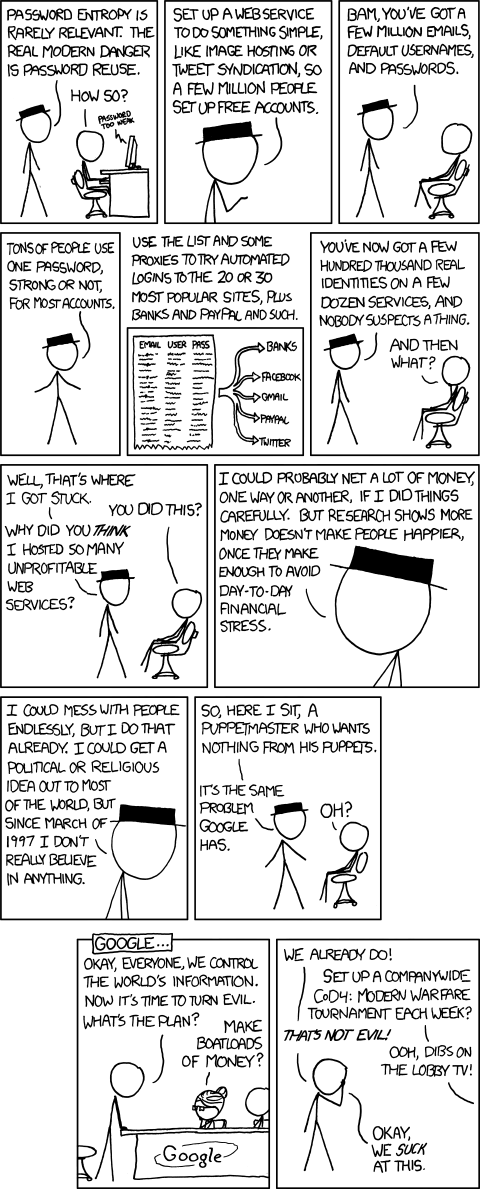
Don't reuse passwords across services
This is a really big problem. I'm not gong to explain it. I'm going to let xkcd explain it for you

http://xkcd.com/792/

Funny comic. Serious problem.

Even if a site isn't out to get you, you have no idea how good/bad their security is. It's that weak link in a chain metaphor that people are prone to harp on about. This same metaphor is good for talking about the one person on your network/system who has atrocious password practices. 


Don't write down your password
I wouldn't have even mentioned this one, except that it came up recently when I found out that it is being taught at my brother's expensive high school as a way of remembering passwords. No!! Bad expensive high school. Very bad! 

This is ridiculous. Don't ever do this.

This is an absurd habit to get into, and is an incredibly irresponsible thing to encourage others to do.

I could tell you stories. Crazy stories. Instead, I am going to tell you about a very dumb thing that I did.

Some years ago when I started a new job, and I was inundated with nine logins with random string passwords in two days, I wrote down three that were behind other logins. That is just an excuse, and it was still a super stupid thing to do.

Well before the end of that week I had changed the passwords to something else, and left the note in my top drawer as a reminder that I am very often prone to doing incredibly stupid things, where it was found at a later date by the data manager in our office. How embarrassment!

Remembering a multitude of passwords is a good skill to cultivate, and is something that will become even more relevant in the future.

It is better to be inconvenienced by forgetting a password than to make it accessible to others. Especially in a professional scenario where there is an IT department who can reset it for you. They do have better things to do than reset your password, but I promise you that they'll be far more annoyed if they ever have a serious breech.

There is this whole problem with this too, in that I would frequently argue that the security checks used to reset a password are far too often incredibly insecure. That is a story for another time though.

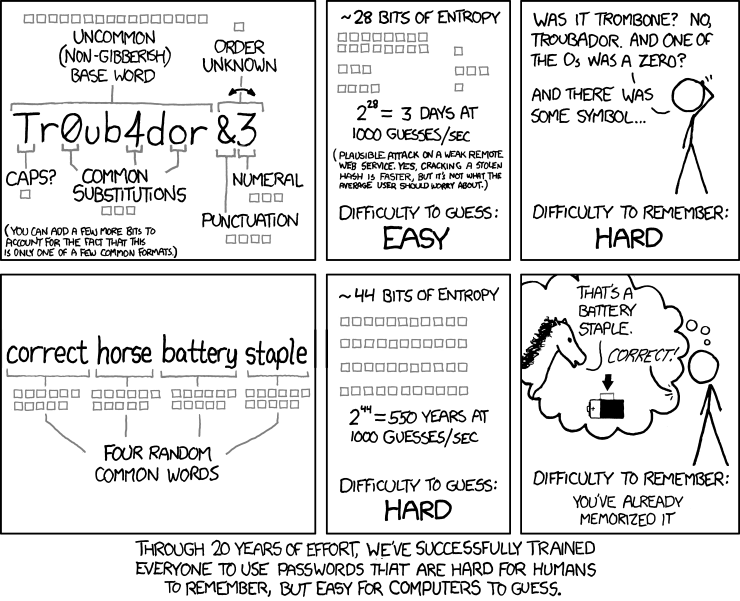
There is this whole misconception about password strength anyway, which is covered pretty clearly by this xkcd comic on password strength.

http://xkcd.com/936/

I guess the real takeaway from all of this is that you should be reading xkcd. It/he is the business. You will be totally emsmartulised. Also, it is funny.

Cleverness is the wombat's cummerbund. It increases one's nattiness.

Saturday, 19 July 2014

Are you rubbing your computer on complete strangers?


I am occasionally reminded that I have spent most of my professional life as some breed of 'IT guy'.

I guess, in my own head I have always imagined myself as one of the 'wise-cracking iconoclasts built for grander things' subspecies. I also sometimes like to pretend that I am a bear, but that doesn't make it so.

As one of those 'IT guy' things who isn't a bear I am acutely aware of the effects of poor computer hygiene. People just sort of switch off, and cruise around rubbing their computer on every strange thing they can find. Digitally speaking.

It's bizarre.

To me, it's pretty weird that people don't seem to pay attention to the URLs when they get search results. This really is Not Rubbing Your Computer on Strangers: 1001. When I find out about this I tend to worry about them visiting places like Tijuana, or Bangkok.

Here are the first three results I got when I Googled 'mozilla firefox'.


Clearly the first one is an ad for a Mozilla Firefox download, and then the next two are not ads, with one going to the firefox download page, and the the third going to the Mozilla homepage.

It is not uncommon for companies to advertise with the same search criteria that their sites would be SEOed towards, so the fact that it is paid isn't necessarily a give away, but the URL for the first result  is mozilla-firefox.ez-download.com/

The postcode for this address is in Scam City. You will be getting malware.

Following this link will lead you to a page that looks like this, which to most people looks pretty legitimate.


It even has a disclaimer that you won't read, just like all the safe sites.


A disclaimer that contains this little chestnut.


This sort of statement is surprisingly common. You might not expect it, but it is. Hence the surprise.

I think it comes down to them not getting in trouble with Google for duping rubes, so that they can keep their sweet advertising spot.

The fact that they've said it doesn't really matter though, because most people don't read disclaimers, and most people don't pay attention when they are installing things. It's actually a fairly standard method for getting malware and poorly designed and coded toolbars onto people's computers.

It's really common. So common in fact that the first page of results for my Google search had five opportunities to experience the thrill of installing malware:

Firefox download with bundled malware (Ad)
Firefox download
Mozilla homepage
News about Mozilla Firefox
Firefox download with bundled malware
Firefox Wikipedia entry
Firefox download for Android through Google Play
Firefox download with bundled malware
Firefox download with bundled software (I haven't looked into whether or not it is malware)
'In-depth Articles' results

This isn't unique to Google searches, or Firefox distributions. I have come across examples on most search engines that I have used. Honestly, it is probably all search engines, but I filter it out these days, and tend not to take note of them.

I know a lot of you are probably thinking that you would never be caught out by something like this, but I see the evidence of it on a lot of computers. I've seen it on the computers of IT professionals, and ICT students, and programmers, and high school computing teachers, and a lot of the more tech savvy people that I know.

It is ridiculously common.

Even if you think you are absolutely super awesome with computers, and you never use them to Google Pandas or kittens or some such, and you've got a dozen top tier raid toons, and you've finished the internet, and totally pwned the boss fight with Mark Zuckerberg's left testicle, and you don't use aim assist when CoDing n00bz on your XBone, you should heed these words.

Especially if you are any of those things.

Tuesday, 22 April 2014

Backing up for Improved Wordy Prowess


There is this terrifying thing that happens sometimes, and it is the kind of thing that can rock you right to wherever it is inside you that your words are made. I don't know why I don't just say what it is straight up. You've seen the title, so you must know where I am going with this.

Losing all, most, some, or even only small amounts of your writing can be devastating. I have had all of these happen. Well, I thought I lost everything once, but I had a bunch of bits and pieces here and there on Zip disks, and as e-mail attachments, and what have you, but it took a very long time to get a lot of it back together, and I lost versions of things I have never since been able to replicate. I also lost all known versions of some stories, including what was at that stage the longest and most complete thing that I had ever written.

The process of recovering from this is horrible. You aren't quite sure where to start. Do you just start pouring out everything that you can remember? Where do you start with that? Losing a few small stories is not a good feeling, but losing dozens of stories, some of which are tens of thousands of words, is sickening.

There are a number of reasons that things like this can happen, but the most frustrating is when whatever method(s) of backup you have decided to go with are the failing point. No one method is infallible. External hard drives will just die one day, online services may change their policies on you, and all recordable media will eventually corrupt. Any of these can turn into an expensive and/or futile retrieval operation.

We need to protect our words. We need to make sure that they are going to be safe. we need to make sure that they will always be there for us when we need them. That is why I am talking about this now, instead of talking about it after the cool software that exists. This is way more important, and has very little to do with writing, and more to do with protecting your writing.

Ideally you want everything backed up both locally, on an external hard drive, flash drive, or other external media, and in the cloud in one of those cloud services. I live out of my Google Drive, because it is big enough and it is free. It was there for me when I was ridiculously broke, and so I'm invested now. There is a relationship with Google Drive that makes me feel that my things are at their safest when they're with the 'G'. The other major player is Dropbox, which plugs into everything these days, which is great. This compatibility is very important for a lot of things, but there are always going to be some file syncing issues no matter which services you try to use, so it is good to try and be aware of them.

I would steer clear of SkyDrive, only because they once changed their policy on me and I lost access to all of the things that lived there. I had quite coincidentally backed it up a few days before losing access, but I still maintain that there was a poor effort made to notify me of these changes and what they meant for me and my words. Will they change it again? I don't know, but I am not particularly interested in finding out.

A friend of mine makes use of a number of these services, because 'they're all idiots', which isn't a totally bad idea. It is actually a pretty good idea, and while making sure they are all up to date can be a bit of a chore, it is worth the time for the piece of mind. A few years ago I experimented with having them all overlapping, because I was curious to see how it be handled. It turns out that it causes some file duplication issues, as well as some syncing problems if you have more than one of them installed on a machine. If you're super keen to do this, I suggest putting the others inside your Google Drive, and only installing your Google Drive on all of your machines. You will still sometimes have issues, but...

Actually, don't. It is a pain. When things go wrong, I seemed to be always finding out when it was inconvenient to actually resolve the issue. Unless you are on top of this kind of stuff and you manage all your own IT toys, this has the potential to really annoy you. Keep them separate. I got into this a couple of years ago now, and I could imagine them being able to fix this, and having it not be an issue anymore, but I can also imagine them not prioritising it, because making sure their products play nice with their competitors' products so that you can pay them all zero of your money is not the kind of thing that they are likely to make time for.

When you are signing up for any service, whether it be for backing up, online tools, software support, hardware support, or anything else you don't ever want to lose access to, it is important to use an e-mail address that you 'should' never lose access to. Do not use work/school/university/group/organisation/friend's/partner's/family's/shared/ISP e-mails. This has often struck most people as the kind of thing that falls well inside common sense when I tell them this, but most of the smartest people I know have done this at some stage in their life. Even an e-mail that you have been promised 'for life' is not guaranteed, as these promises do not usually reflect the actual contracts, service agreements, or policies involved in their delivery. I should also point out that I have told people this, then had them give me a hard time for patronising them, and then had them do this very exact thing less than an hour later. If keeping access to an e-mail address is reliant on you maintaining your involvement in a workplace, organisation, or relationship, DO NOT USE IT TO SIGN UP FOR THINGS!

The safest thing to do is use a Gmail or Live/Hotmail e-mail address in your own name. Other similar services, like Yahoo, are fine too. This is one of those things that you should probably adopt outside of your writing life too. This is fairly solid advice. The likelihood that you will be able to maintain your non-fee-paying relationship with an organisation like Google is far more reliable than the likelihood that you will always be with Optus/Telstra/<current employer>. In the situation in which an employer has provided you with a Gmail account (yes, this is a thing), get your own.

While we're on the topic, if you feel like you need to chime in about the unreliability of modern technology and you keep everything in hard copy, then you are going to get burnt one day. No pun intended, but it was definitely appreciated. I used to do a lot of writing on a type writer, because I like the noise it makes, and even though I never got literally burnt, my writing got wet, and I lost a huge amount of work. I was young, and the whole process was an indulgence that ended in a hard-learnt lesson.

No matter what process you use, things can go wrong, and you will never stop feeling amazing when a computer dies, or a backup fails, and you can get everything you have ever written onto wherever it is you are writing on now with a minimum of fuss. The feeling you will get whenever you watch those file transfer bars creep across the screen of a clean computer will never stop being one of the best parts of your year, and in my experience, will only get better and better as that folder increases in girth.

Saturday, 5 April 2014

Tools for Improved Wordy Prowess


There are purists that argue that if you are a 'real writer', all you need is a pen and some paper. Maybe a few pens. The quantity of pens and paper is dependent on the length of your writing endeavour and your affection for rewrites. I think we should take it a step further. I believe that if you are a real writer, then all you need is your mind.

A real writer is engaged with the process of the art, and remains entirely apathetic to the final product. After all, if we were at all concerned with the final product we would make movies, the worst of which is a lot better than any book could ever be. The trick is in convincing others that they should pay for the book that you have written in your head. There are two obstacles that you will need to overcome. The first being whether or not you have actually written the book, and the second being the quality of the book. Both of these hurdles are easily circumvented through the liberal application of hypnotism. Hypnotism can also be used in a variety of non-literary scenarios, and I recommended it as a skill to be cultivated regardless of your intent to become a writer.

If you are in fact more concerned with putting actual words together into a final product that others are able to participate in without the use of mind reading, then an exclusive pen and paper set up may not be the way to go. You will probably need a variety of tools. Some different coloured pens, maybe some pads, a typewriter is fun, desktops are useful, laptops are better, and software is awesome.

There is a lot to cover here. I mean, the tools and arrangements that will change your life, are not counted upon a single hand, outstretched or otherwise. It is about being prepared, and making sure that you are prepared to operate in any given scenario. You will be like a Batman of words, except your stuff is not going to fit into a utility belt.

If you want a single tool to solve all of your problems, then I am going to disappoint you quite extensively, repeatedly, and probably on a number of levels. Unless you are doing only one very specific type of writing, then you are going to need some toys as opposed to one toy.

To absolutely contradict myself I am going to say that the one tool you really want is a laptop. This is the best case scenario. You can write pretty much wherever you need, or happen, to be. You can take it to interviews, or meetings, or the library for research, or cafes, or my mum's house. Well, not my mum. Your mum. Unless you know my mum, and she wants you to visit.

That said, there are ergonomic and productivity concerns with laptops. They aren't really good for you as a primary writing implement, because laptops on their own are basically RSI and neck pain machines. Then the screen space available is also going to drive you up the wall when you are in big edit mode. Fortunately you can get a monitor, keyboard, and mouse for your laptop and treat it as a desktop when you are at home.

The ideal scenario is a MacBook Pro or Air, and a Thunderbolt display with appropriate peripherals, because they have been designed as docking stations for your mobile life. But, starting at just under AUS$2,500 this isn't within everyone's price range. That is also before you start buying any software. So, how do poor, struggling writers get them some tools of the trade? And what tools should we look for?

The four 'F's of acquisition. Friends, family, found, and Freecycle (and similar services). If someone is throwing out a laptop, or has one sitting in a cupboard that they don't use, they might be willing to pass it on. Word processing is, generally speaking, not a hugely taxing activity for a computer. It can be, but that is usually when formatting and tracking changes, or poor memory handling if you happen to own some versions of Microsoft Word for Mac. If it is portable, and it works, it'll do. I've even part-timed a laptop in the past in order to get some writing done.

Monitors can be similarly acquired, but you will need to make sure that they are compatible with whatever display port your laptop has. There are a few different types of display port, and it is worth knowing what you have because you might need an adaptor, or preferably a converter cable (has a different port type on either end). Converter cables I find stay plugged in more securely, which is a plus for something that is getting plugged in and unplugged on a regular basis, and they're also, quite bizarrely, cheaper.

A mouse and keyboard will set you back maybe $10-$15 dollars depending on where you shop, but they are again something that people tend to have lying around, and may be willing to part with.

If you have some money, and don't really want a bunch of second hand computer stuff, which can be a valid concern, a new low end laptop, monitor, keyboard, and mouse can be picked up for as little as A$550, but this is also highly dependant on where you shop.

The one laptop accessory I think that everyone should own is one of those padded lap table things. They're pretty awesome even if you don't own a laptop. So many uses. I have no idea what they're called. They're called lap desks. I just googled it. Google wins again. So, lap desks are amazing. I'm not really sure how ergonomic they are, but they are fantastic for sitting the wrong way on a sofa, or in bed, in the garden, on the floor, or pretty much wherever really. I use mine a lot. A lot, a lot. Especially when I'm editing. You can get them around the place for a relatively small amount of money. I've seen them as cheap as $7, but the one I have was $15.

There are more parts to this, because the original draft got crazy long. About four times longer. You're not going to read all of that. Not in one go. There is a good chance you didn't even make it this far. But, when I post the other bits I will cover backing up all of your writing, as well as some software that will probably change your life. That might happen a few times. The software, not the life changing.

Saturday, 22 March 2014

The Days Ahead


To some degree, I find myself thinking about the work of William Gibson more frequently due to the work that I do and the way that I live. Not that I am a writer like he is, though I do and have written web copy, which is a kind of corporate, wired up sort of writing that lives in the worlds hewn with his own, but the vast majority of my professional life has been as a freelance ICT professional. Not that I ever call it that. That doesn't happen. There are other words that are often more specific. The technology bases covered are diverse and far reaching. I often think of the work that I have done, and the work that I do, and there is a relationship to the organisms that populate cyberpunk. I'm one of those. That's what I think.

I've had the speak wheeled at me in a variety of fashions, I've lied to printers to make them distribute ink in the manner for which they were originally designed, trawled through archaic data on dying systems at the behest of its owners, and coded towards functional artificial intelligence. That's not all of it, but it is some of it. I may not be the neuromancer, but I'm playing in the same parks. This is the world I live in. I'm pretty sure I've eaten synth-spaghetti, and probably slept on it. In reality it is the world we all live in, though your eating habits are your own.

The synth-spaghetti stained days of keyboard-for-hire are a part of something else. The journeyman years. They have a function. They built who I am, and the way that I learn.

These are important days.

The Prophets of Cyberspace: A Rough Guide to Cyberpunk v1.0.3

originally posted on 2010-04-26-0223
at Ray-guns and Spandex
migrated to Sci-Fi Snot Rash

In the late seventies a new flavour of science fiction began to take shape. It's earliest visible family characteristics had first appeared in both 'new age' sci-fi and the authors of the beat generation. In the intervening time it had slowely formed a new definition for itself through the works of J.G. Ballard and Philip K. Dick, until reaching a point in the early eighties when the cultural obsession with excess and mass media provided the perfect literary genesis pool for the emerging counter culture prophets of cyberpunk.

Abandoning galaxy spanning empires and laser toting aliens in favour of more familiar settings. Abandoned territories and near future cities became neon wombs breeding cybernetic street gangs, corporate warriors, and digital pop-stars. Cyberpunk takes us into worlds not that far beyond the horizon. Deeply entrenched in the mundane with elements just alien enough that they might be happening in another city, in another country somewhere, instead of on the other side of tomorrow. In the three decades since its first oredictions we can clearly see that the anticipation of the popularity of reality television and the total pervasion of the internet happened somewhere between Bruce Sterling's The Artificial Kid and William Gibson's Cyber Space Trilogy.

With much of the origianlly fictitious elements of cyberpunk having become parts of our everyday lives it comes as no surprise that many other brands of modern science fiction carry these same elements that were at one stage the calling cards of cyberpunk without fully submersing themselves into the stream. The Matrix is more thematically in sync with post-apocalyptic or machine war SF than it is with cyberpunk. Link all mimics of any punk movement, they wear the colours, but run in different circles.

It was never just a collection of hacker stories set in glass walled mega-cities and the suburban wastelands that surrounded them. It's a voice and an ethos defined by the very culture that birthed, where the corporate world has adopted the methods and tactics of the street, wrapped in a setting that is thrown at us. Chapters barely clock in at a page, and read more like scenes from a film. And the pacing of the books are measured in frames per second, with the charging mbps of the prose consisting predominantly of artificial street speak, and stream of consciousness.

If you are interested in running deep in the pure flavour, books like Snow Crash and Blood Music deliver in spades, but if you are a sci-fi film junkie, Cypher, New Rose Hotel, and Natural City are uncut, and measured from the source.

For me and my money, nothing sits closer to the heart of cyberpunk than the literary link hopping of MirrorshadesBurning Chrome and the erroneously named Rewired: The Post Cyberpunk Collection. Short story compilations straight from the aforementioned neon womb in portions that have been coded and optimised for the short attention span generation that shared its childhood.

Thursday, 24 October 2013

Dance like everyone is watching

When it comes to the neuroheadset, the one specifically that exists in my life, there have been a number of questions. The most of them aren't remotely important to the work that I am doing, except as an exercise in explaining my role with increasingly efficiency, which has its own usefulness.

My role, which is primarily involved with validation of research, makes use of a neuroheadset that is not considered, by research standards, to be 'high resolution, state of the art equipment'. People question this, because there are bigger, better, and more bad-arse tools of choice roaming the halls of validation. The thing is, validation is difficult for a number of reasons, but probably the most frustrating thing is that most of the tools that we use for validation impact the results of that validation. Whether it is a camera, an audience or a state of the art neuroheadset wiring us for a better future, we are likely to perform to the camera, the audience or the headset. It becomes an invader in our environment, and the more unfamiliar it is, the more likely that we dance differently.

As technology pervades every corner of our existence, we adjust and it becomes a natural part of our environment. Not natural in that it grows on trees, but 'natural' under a definition that has not been co-opted by a specific agenda. This is where consumer grade electronics, as those electronics that exist at a price-point that is reasonable for people to purchase and use in their own homes, have the distinct advantage over The State of the Art.

If we can use the output from the camera in a $100 phone for rudimentary motion capture, that device becomes useful in gross motor skills training and assessment. You put that phone in the pocket of a competent athletics coach, you have less sports related injuries amongst adolescents. In the pocket of a competent physiotherapist or occupational therapist you reduce the longterm effects of prolonged injury or physical development issues.

Even though we dance differently for the device, it's familiar enough that we don't dance so differently. At the moment when we are rigged for neurovalidation, the duration of setup, number of trained professionals, geographical restriction and sheer size, complexity and alien nature of the 'device' all contribute to the way that we dance.

The neuroheadset that we are working with is high-end consumer grade electronics. It isn't a $100 smartphone being handed out with basic contracts. Not yet. Emotiv are working on another model, that is lighter, cheaper, easier to use and maintain, and (above all else) looks even more like something that you might find sitting on someone's desk next to their headphones. This is a device that we will find incorporated into game design and adapted to monitor concentration, sleep, and relaxation levels. It, or something like it, will become a part of all of our futures, and then we can see how you dance.

Tuesday, 1 October 2013

All our wired futures

There was a recent discussion in Australia about the merits of the Labour Party's proposed National Broadband Network, which would see nationwide access to extraordinary bandwidth. The infrastructure for high-speed internet would be available to everyone, not just those that could afford it. The most frequent argument against their plan focussed on our current need for such a bandwidth, of which there is admittedly none. We do not need access to this bandwidth now, but we will need it. The best time to build infrastructure is before it is required.

The discussion stopped after the election, when our communications infrastructure future was decided. The Liberal Party's Fibre-to-the-Node plan will not future-proof us, it will create a system in which new tools will not be supported, and new tools will not be created. With such a small percentage of the population  able to justify the cost of fibre-to-the-Home, few will take it up, so few developers will see the point in developing high-end services, so no one will bother upgrading. The argument is cyclical.

The Labour Party NBN was a future of possibilities. In its scope it would've been a wonderland of centralised health networks, high speed government records searches, increased Australian internet entrepreneurship, and truly (most importantly) incredible educational services and resources. Under their proposal we would've been future-proof.

If you can't see the possibilities, the problem isn't the technology: the problem is you.

Wednesday, 18 September 2013

Boxes and drives on the interbutts

I had a Dropbox account quite a while ago, and for whatever reason that it was at the time I never really got into it the way that I have recently. I couldn't tell you what it was that failed to grab me the first time around, but I eventually forgot which e-mail address was attached to the account and abandoned the whole endeavour. I'm back now, and I get it this time. It makes a lot of sense to be signed up.

If your electronic things number to many, the convenience provided by any kind of cloud storage is invaluable. Pads, phones and tablets seem to have a better time with Dropbox though. It runs deep. It's integrated up the wazoo. It feels like every second app I use on a regular basis is ready to give whatever it's up to to the rest of all of the things that I have. This is more than can be said for Google Drive and SkyDrive, which both seem to be totally content with their own extensive self integration.

I also like my Google Drive. I pretty much live there. All of my work, uni and writing files are there. Actually, pretty much everything except for media and code. I generally don't keep media in the cloud and I use bitbucket for code. For everything else, Google Drive more than meets my needs.

I've given up on SkyDrive. That is my official stance for the time being. I was kind of into it for a moment, but its convenience was based entirely on some strait arse situational specificity whose boundaries became frustratingly apparent. I've had a lot of issues with SkyDrive that revolve around browser support and plugins. I'm not sure if this has been resolved, and to be honest I'm past the point where I actually care anymore. I don't feel like I can rely on it, which defeats the purpose of such a service. If you live your entire life inside the Windows box, especially the Windows 8 box, SkyDrive might be a kind of okay option for you, but I'd probably still sign up to one of the other major offerings instead.

I run Google Drive and Dropbox in tandem, along with a couple of other specialist services. I'm very happy with this arrangement, and it works very well for me. I'm not sure I would be truly content in my cloud storage without any of them. That said, I was completely content with SkyDrive and Google Drive at one stage, and it is only now that I can see what I was missing out on. Sign up to all of the things, and figure out what works for you.

Monday, 8 July 2013

I am not the Neuromancer!


I've been busy. My brain has been operating on a different level than I am generally used to, and as a result my productivity has been low. I've played some games, which can be a kind of time hole, but isn't always negative.

My adventures in the cyberpunk were interrupted. There were issues with the EPOC, which were initially based on 'it's not an EPOC', but later based on other things, like a table leg. I kid you not. My table leg is made of metal, and it is near the wireless dongle for the EPOC headset. This was a problem that a $4 2m USB extension cord from my local MSY has rendered resolved, but I did have to roam the forums for awhile before discovering that this might be a problem. I also downloaded the wrong software, which had nothing to do with the version of the headset, and everything to do with not trawling the forums to double check that the software did what one might argue was a reasonable assumption that it would do. In this case, that reasonable assumption being that it would receive signals form the hardware.

It is working now and I can play with it. Which is great. I'm not really sure where I am at with it, and I don't know what I really mean by that. It's there and it's working, but I've been really tired. This hasn't stopped me from playing with it, but it has stopped me from really get as much out of it as I had planned. I am planning on being more focussed this week, so we'll see how that go.


Errata:

I got excited about the Steam release of System Shock 2, and got straight into praising its little boots off. I did include a disclaimer that included words to the effect that it had dated horribly in the graphics department. I've sunk about 10 recent hours of my life into it, which has led me to the opinion that 'it looks fine'. If survival horror is your thing, then this is probably going to be one of the best games you ever play.

The EPOC is an EEG which was 'the other one' that I mentioned earlier.

Microsoft displayed some alarming gymnastic ability, when the whole X-bone thing backflipped wildly after E3. Whatever is happening with it is different to previously stated. I got into it not once, not twice, but thrice. In the end I don't really care about the X-bone. I was startled by whatever was in the water over at Microsoft headquarters, but I am not interested in the commentating the next generation of The Console Wars. I've seen a few, and I get enough poorly informed factional nonsense in Australian politics.

Tuesday, 18 June 2013

EPOC: Brain Computer Interface Technology


There has been previous mention of the planned goings on that were to go on once I had completed my last exam, and they have now that I have. I am of course talking about sending messages from my brain to my computer without utilising those avenues upon which my brain is traditionally reliant. This was managed through the use of an EPOC neuroheadset, produced by Emotiv. It would be completely fair to say that the EPOC is not state of the art. This is an opinion about which I am pretty confident, and one that is supported by the other one produced by Emotiv. It isn't always strictly important to be state of the art. I couldn't tell you what is always strictly important, because if I could, I wouldn't tell you. Not here. I'd tell you in a book for $49.95, or $22.40 for the e-version.

What I can tell you about the EPOC is that it has some limitations. The specific limitations aren't important. Not here they aren't. Not for my words that I'm saying at your eyes. They're important in regards to development, but the story works out the same, which more or less breaks down to (1) what blood we can wring from this stone, and (2) what the next stone should be like. I'm talking about stones because stones have a multitude of applications, and have been involved in a variety of important technologies. What turns out to be really interesting is what we suspect it can't do, but we later find that it can.

I should also mention that it isn't just limitations in a pretty box. It works, and it does so in much the same way as it promises to work.

That is about all I can really tell you about this technology at this juncture. I'm new in town, which means I have some catching up to do. That there though is the game, and it is afoot. A friend (I like to think we're friends) recently said, "If you get involved in tech, and you're happy to keep thinking and learning forever, then there's so much to be done!" I'm onboard with this, and I'll probably info-dump the things that I'm learning somewhere in this general e-vicinity.

Saturday, 15 June 2013

Hello, future

I was having a discussion with a lecturer of mine about my own futures. The ones that might happen, and the ones that I would like to happen. In this discussion, he brought up a number of projects that I might like to be involved in during my time at university, and he mentioned using neuroheadsets as user-interfaces.

The idea of a neuroheadset is a real thing, but once upon a time it was wild. It used to be a denizen confined to our fantastic imagined futures, but now they are manufactured and put into boxes. This thing is deeply ingrained in the previous mythologies of tomorrow. At one stage it was impossible nonsense. Impossible nonsense that now comes in a box.

Everything happened really quickly after that. I was talking about the things that interested me, while trying to remain cool about the fact that I seemed to have walked right into a William Gibson novel, and I ended up signing for this impossible nonsense in a box.

The way they arrive in your life totally defies the mythology. There are no nondescript black cases. The box is the very essence of consumer electronics, al the way down to the topless, Hong Kong neo-pop princess on the front. It is a product that is brain computer interface technology. It says so right there on the box. Nothing appears to be hand crafted, which makes sense, because apparently we are living in the future now. You want it to be made with the loving consistency that only a machine can repeat. There was no secret transport ritual. I took it home on the train.

I am studying for an exam for another subject, so for the time being it stays in the box. Well, it has gone back into the box.

I kid you not, this is literally the kind of thing I have been fantasising about for at least twenty years.

Sunday, 9 June 2013

X-bone, phone home

There are a few articles that have covered Microsoft's double back-peddling 'compromises' on both second hand games and the whole always connected things, but this one is my favourite. The best part of which was when they said, 'Some players had been concerned that the console was going to require a constant internet connection.' This is ambiguous, and implies that players were concerned that it might require a constant internet connection, when in reality players were concerned when Microsoft announced that it definitely would require a constant internet connection.

This whole thing feels like Microsoft is stress testing consumer relationships again. Either that or they have absolutely no concept of how far is too far, and are fully reliant on customers to draw the lines. Maliciousness or incompetence. I remember asking the same questions when Windows Vista oozed onto the shelves.

Tuesday, 7 May 2013

Hey, Microsoft! 'Pavlovian' is so a word!

I am working on a proposal for an online complementary informal learning platform as part of an assignment for Principles of Professional Communication (PoPComm), and Microsoft Word 2011, keeps insisting on red-squiggling 'Pavlovian'.

Seeing as Pavlovian conditioning is what is most commonly thought to be responsible for computer game addiction, I would have thought that this would have been a clearcut inclusion for the dictionary.

Gmail is all over it.

Monday, 6 May 2013

Mastering Windows 8 and the Hitchhiker's Playlist

I have been up to my unkempt little tufts in assignments lately (which among other things has distracted me from cutting my hair, hence the tufts), so I haven't really had much time to think about anything that isn't directly related to a subject I am doing at uni. Despite this situation, I thought I might share a story and a wondrous discovery.

The story goes like this: Friends of mine had a computer that had started returning harddrive errors (that's brain damage for your computer). I recommended that they pick up a little Dell desktop sporting the often mocked Windows 8 nearly solely on Dell's high level of customer service and technical support. I was a little concerned about 'The New Windows' (which was the only OS available for that model), because one of these friends had only recently referred to having two documents open side by side on the same screen as 'a trick that [I] should teach [him]'. In the end I thought, 'They keep regular hours. They can just call me if they need to.' Anyway, I have just this morning been regaled with a tale of discovery and confident navigation of Microsoft's, supposedly unfriendly, Windows 8.

And my wondrous discovery is this:


I didn't even know this much of it was out there. The 38 second radio edit that later ended up on TV has been circling my brain for years. This discovery had nothing to do with the looming Towel Day, but while we're here in the vicinity I thought I might mention the worlds oldest web translating service and a far less serious user written free online encyclopaedia that predates Wikipedia.

Monday, 1 April 2013

Bad at maths, good at customer service? Work for Microsoft!

I have recently returned to university and I am meant to use Microsoft Visio Standard 2013 for a number of of my university assignments. We have the 'option' of using it on the computers at uni, as the software is prohibitively expensive. While looking online to see how prohibitive the pricing was I came across this:


$300 doesn't seem so unreasonable to me, not that I have $300 that I could spend on anything right now. I clicked 'Buy now' with the intention of getting as much information on it as I could, and found myself presented with this:


When I called the Microsoft Store and asked what additional features warranted the 83% price difference (based on the exchange rate at the time of writing), I was told that AU$539 was US$299 due to the current exchange rate. When I informed the diligent little Microsoft monkey that he was operating on bad information, and that AU$539 was actually closer to US$560, he apologised for not being able to explain the discrepancy and then offered me some actually useful advice. He suggested that I find a way to set up a US mailing address and then order the product, and as long as the process didn't cost me US$260 or more I would be getting a discount.

This 83% koalas on keyboards tax isn't unique to the Microsoft Store. Check out the price differences over at Adobe, the Apple Store, all computer game distributors and just about anyone else who distributes software. The problem is a long standing issue, and something that I have griped about for decades. In my formative years I would often read US computer game magazines, and was shocked by the price listings for games. That was Twenty years ago, and our dollar is a mightier thing than it once was (thank you Paul). In particular I thought that perhaps things would start to change in the wake of digital distribution, but in reality there are very few digital distribution services that do direct (or nearly direct) exchange rate conversions (Steam is the only one that comes to mind). The vast majority are happy to price us like it's 1984.

Anyway. Thank you Microsoft. Thank you for hiring people who actually want to help your koalstomers, even when you don't.